
Tales from the Cloister: Godden, Murdoch and Spark
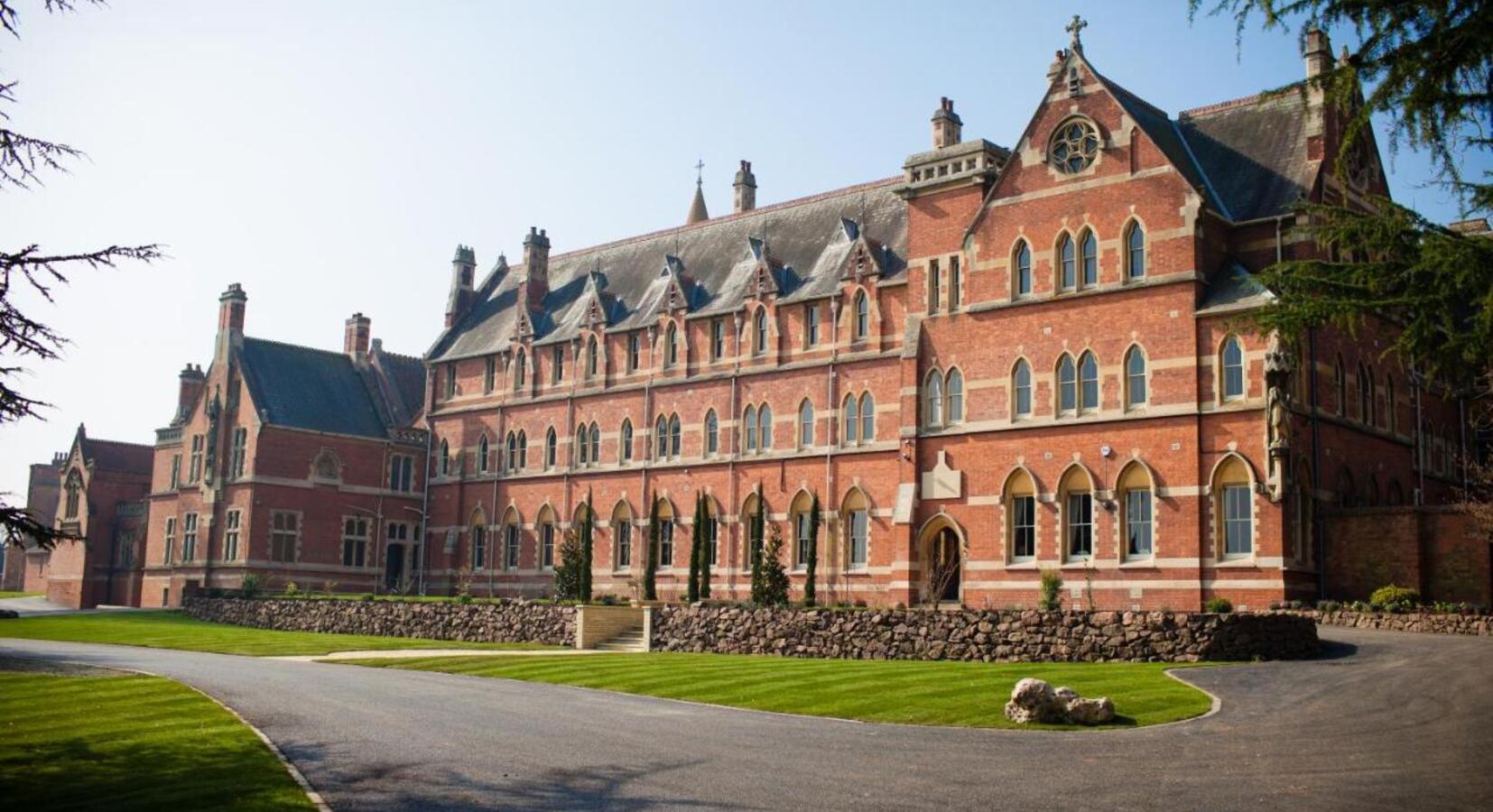
The former Roman Catholic Abbey of Stanbrook in Worcestershire has a long association with writers. Indeed, a past nun, Dame Felicitas Corrigan, published a number of biographies, winning the James Tait Black award in 1986 for her biography of Helen Waddell. Corrigan’s most famous work, inspired by her superior’s epistolary friendship with George Bernard Shaw and Sir Sydney Cockerell, would go on to become a play, ‘The Best of Friends’ in the West End, and later adapted for television. It was published in 1985, but arguably a more important literary event at the Abbey came decades earlier.
Both Iris Murdoch and Muriel Spark stayed at Stanbrook in the July of 1954 (Murdoch’s first novel, Under the Net, having just been published), although it is unknown if they crossed paths. Murdoch was visiting her friend from Oxford, Lucy Klatschko, who had joined Stanbrook in the May of that year. Murdoch would draw on her experiences here, and at Malling Abbey in Kent, for her fourth novel The Bell (1958). Spark visited for quite another reason. She had converted to Roman Catholicism on 1 May 1954, having only been baptised in the Church of England the previous year, and was trying to escape her overbearing partner, the poet and critic Derek Stanford. This second rocky relationship, following her divorce from Oswald Spark, prompted her to look elsewhere for a deep connection. She wrote to Stanford: ‘If we were constant beings by nature, like angels, it would be easier. But we are flux, mere flux. No, not 'mere' flux – necessary, right & proper flux.’ Spark had spent the Christmas of 1953 with Roy Foster, the Anglican vicar of St Augustine's in Kensington, and this was a crucial moment on her path to Rome. The new year found her taking formal instruction at Ealing Priory, and she was received into the Roman Catholic church. Her instructor, Dom Ambrose wrote that "I was so pleased to hear you were so happy, you looked radiant." However, all was not well: Spark had become addicted to amphetamine and was stuck in an abusive relationship. She would later suffer a breakdown prior to the publication of her first novel, The Comforters.
In the July of 1954, a mere two months after her conversion to Rome, Spark was actively considering the religious life. She was advised by Dom Ambrose to travel to Stanbrook, and stayed for a week in the Hermitage, the guest house attached to the Abbey, which was also where Murdoch stayed. She was drawn to the routine of prayer and private study, alongside the opportunity to be with like-minded women; she never broke off communication with Stanford, however, and continued to write to him regularly. She ‘borrowed’ a variety of books focused on the Book of Job and these would be essential for the rest of her life, as well as being the major influence on her seventeenth novel, The Only Problem (1984). Only the books of John Henry Newman were equally important to her developing Catholic belief. She considered other religious orders but preferred the Benedictine life. For Spark, a life of obedience did not hold much promise; there was also the question of how she could continue to write and publish what she wished under the watchful eye of an Abbess.
After this, Spark returned to London fresh with literary ideas but with various situations unresolved. In October she went to visit the Carmelite monks at Aylesford Priory in Kent. This was a much longer stay and – unlike at Stanbrook where she prayed and read – at Aylesford she began to write, indeed after a month in the guest house she moved into a cottage in the grounds of Allington Castle nearby (the cottage being owned by the monks), and she stayed there until mid-1955. During this period she formulated and began to write the first five chapters of The Comforters, which was published in 1957. It is interesting to note that although she mentions Aylesford and her work there, she does not mention her desire (however fleeting) to join a Benedictine order in her autobiography. Perhaps by the time she came to write Curriculum Vitae in the early 1990s the idea had become almost laughable to her.
Murdoch’s connection with Stanbrook would be much longer lasting. Although she never visited again, her letters to Sister Marian continued throughout her life. This was a formative moment in Murdoch’s life as she contemplated her own Christian beliefs, arguably moving closer to Christianity as she left her earlier communist and existentialist leanings behind her. Although she never considered being cloistered herself, in a letter to Sr Marian she says ‘May it be all that you hope, and much more that cannot be imagined beforehand. Take me with you as much as you can.’ Sadly, her journal for 1954 has been self-excised and all reference to that summer has been lost. What remains are the powerful, wise and adept characterisations of the nuns in The Bell, exemplars of earthly goodness set apart from the secular world.
For Rumer Godden, the visit to Stanbrook came later but was, perhaps, the most fruitful of all three. She had already published, in 1939, her most famous novel featuring nuns, Black Narcissus; the film adaptation with Deborah Kerr was released in 1947 and would substantially increase her popularity. In the early 1950s she had gradually become interested in Catholicism but it would not be until 1968 that she would convert. Godden became a much more traditional convert than Spark, who was, much like Graham Greene (another literary convert who would regularly give Spark cheques to tide her over), at odds with various elements of Catholic dogma and morality. Godden was far more settled in her home life than Spark: it was her daughter’s difficult pregnancy that initially caused her to write to the Abbess of Stanbrook, as recounted in her second work of autobiography, A House with Four Rooms (1989):
I met a friend, Leonard Clark, the poet… “what is worrying you?” asked Leonard – he was always sensitive to other people. When I told him he said “Write to Stanbrook Abbey and ask the nuns for their prayers”. It was the first I had heard of a place that has become a lifeline for me.
Dame Felicitas, like many other Stanbrook nuns, has everyday a heavy bag of mail yet it was she who wrote to Jane every week in those months of anxiety, never with off-putting piousness.
Prior to Black Narcissus, Godden was considered middlebrow in the literary world, yet difficult to categorise as she wrote across so many genres and settings, from children’s fiction, translations, poetry and major novels: over 60 books in all. In this House of Brede (1969) marks, I think, a shift in her fiction writing, she would go on to write Five for Sorrow, Ten for Joy a decade after Brede, another novel based in a religious house, although this time set in Paris.
But let us return to Spark’s The Comforters, her first novel and one which directly relates to her experience of enclosed religious life. Whilst ostensibly an oddly pre-postmodern work that considers the effect of authorship on character via the protagonist Caroline Rose, there is a good deal of autobiographical licence used. Much like Spark, Caroline is a struggling novelist who has recently converted to Catholicism and has also just returned to London from a religious retreat. Early in the novel Caroline begins to hear voices, the sounds of a typewriter, and believes she is suffering from delusions – brought on (again, like Spark) from drug dependency perhaps; the words Caroline hears relate directly to her own thoughts, paralysing her and making her question her own motives and sanity. Spark recounts in Curriculum Vitae that the title is taken from the Old Testament Story ‘The comforters of Job’; she believed that ‘the Comforters’ were actually demonic forces whose clear intent was to aggravate Job and drive him against God. Due to Spark’s mental breakdown, during which she believed that there were secret word-game-style codes in the poems of T.S. Eliot, she became so distressed that she would spend night after night decoding. Eliot was moved to write her a letter, reassuring her that there were no such codes in his work. She recovered, but the novel that she poured all of this into also became a critical success – Evelyn Waugh said pre-publication that
The first half, up to the motor accident, is brilliant. The second half rather diffuse. The mechanics of the hallucinations are well managed. These particularly interested me as I am myself engaged on a similar subject [The Ordeal of Gilbert Pinfold]. Mrs Spark no doubt wants a phrase to quote on the wrapper and advertisements. She can report me as saying: 'brilliantly original and fascinating'.
Graham Greene believed it to be ‘[o]ne of the few really original first novels one has read for many years’.
The Abbess of Crewe (1974) was Spark’s second overtly convent-inspired novel (although primarily a satire dealing with the Watergate scandal in the USA). Early on the reader is introduced to Alexandra, recently elected Abbess of Crewe, circumnavigating the issue of electronic bugging in the convent, while there is a visible police presence outside the gates. Alexandra is tall and elegant, ‘like a tower of ivory’. She recites modern poetry in place of the traditional vespers and has the nuns electronically surveilled. It soon becomes clear that there has been a scandal engulfing the convent and that another senior nun, Felicity, formerly Alexandra's rival for the position of Abbess, has departed to live with a Jesuit priest.
Most of the novel’s humour derives from Alexandra's imperturbable calm in the face of chaos and her guileful and downright Machiavellian treatment of her rival, Felicity, and the rest of the convent population. This includes the continuation of Hildegarde's video and audio surveillance systems, used to monitor all the nuns' activities, including Felicity's amorous romps in the garden. Spark was, unlike Godden, no cheerleader for the Catholic church in toto. Whilst not exactly a ringing endorsement for the enclosed life – although very funny in places – The Abbess of Crewe does highlight the influence of both Stanbrook and Aylesford, and her continuing fascination in fiction – and indeed in non-fictional essays that she wrote throughout her life – with Catholicism. A work suffused with satire and politics (not unknown in religious houses, of course) but indebted to her past.
Godden’s In This House of Brede is the most rigorously Catholic and substantial of these novels in relation to the religious life. The protagonist, Philippa Talbot, leaves behind her life and career in London – spurred on by personal tragedy – to join Brede Abbey in Sussex. We follow her, and her life with a variety of other members of the community, over the years (not unlike Sylvia Townsend Warner’s The Corner that Held Them (1948), another excellent cloister-based novel). Unlike Warner’s which stretches over the 14th to 15th centuries, this novel traces Philippa’s life closely. Godden was given the rare opportunity to converse and discuss her novel with a variety of nuns at Stanbrook in order to get every detail correct, and to make sure she did not put anything into her novel that would be ruled offensive to the community. From A House with Four Rooms:
When In the House of Brede was in readable draft, Lady Abbess, as we agreed at the outset, appointed three of the dames (as enclosed nuns of the Benedictine order are known) as Devil’s advocates whose business it was to fault, challenge, or endorse what I had written as need arose. Three against one, I said, that’s not fair. It was certainly formidable. This was the days of the grille; the three sat behind it, upright in their black and white habits, I in my working slacks and jersey, was alone on the other side.
The detail and richness are too much to go into here, but it is worth noting that the most recent edition by Virago included a floor plan, a map, and a glossary; something that Murdoch and Spark – driven by slightly different desires perhaps – would not need. The realism of Brede, of enclosed life as it really is, with the internal life and drama unheightened – is the equal of Murdoch’s The Bell and Spark’s The Abbess of Crewe. The richness of all three bear witness to their real inspiration in Stanbrook, but also point toward the lives and desires of all three authors. The sympathy with which Godden draws her characters makes them feel far more than the archetypes that we find in Spark, or (perhaps) stereotypes in Murdoch.
I recently acquired the second volume of Godden’s autobiography and found inside it an annotated small pamphlet from Stanbrook. This became a guiding light for Godden as she responded to her own readers. This is from the annotations in my copy:
Such letters as yours about In this house of Brede give me a great feeling of reward. When I wrote the book I thought no one would want to read it – it brings letters every week from all over the world, and you have read it four times! Yes, I liked Hilary. I lived with these characters for five years, I thought you might like to see this, that one of the Stanbrook nuns designed to help me in answering letters. It really says everything I wanted to say in the book.
‘We have chosen a stillness more powerful than all activity
A detachment more fulfilling than possession
A wisdom exceeding all knowledge
And a love beyond all price’.
The retreat from the secular world to a religious order was certainly not unusual prior to the Second World War, particularly for artists, but for these three novelists the impact that Stanbrook in particular had on both their writing and personal lives, however fleeting that initial visit, was decisive. All three, in their different ways, experienced a connection with the transcendent that would remain with them, and which became important to the development of their later work.
Miles Leeson
University of Chichester
Note on the text:
This essay is taken from Miles's new book, Visiting Mrs Bayley and Other Essays which celebrates ten years since the founding of the Iris Murdoch Research Center. You can find out more, and buy a copy, here: https://irismurdochsociety.org.uk/product/mrsbayley/
All profits go to the Iris Murdoch Society.